Showing posts with label angst. Show all posts
Showing posts with label angst. Show all posts
Thursday, April 22, 2010
Library thoughts
It's mindblowing how much you have to read just to avoid writing something barfingly stupid.


Friday, April 16, 2010
The end is nigh
I'm counting hours until the end of undergraduate classes forever and ever and ever. This is beyond strange. It hasn't been four years. They're lying to me. My cap and gown are stashed away in my sock drawer, still in their plastic because I'm scared to open them up. I walk in a month and two days.
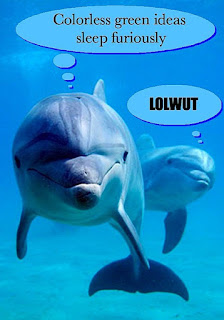
Locked myself in and stayed up for a few days this week staring at this screen and contemplating my thesis with a growing sense of existential horror. Sort of like this, but silently and in a library. I am cautiously optimistic, however. If I keep going long enough, it is statistically probable that I will produce a work of profound insight and great intellectual beauty:
Locked myself in and stayed up for a few days this week staring at this screen and contemplating my thesis with a growing sense of existential horror. Sort of like this, but silently and in a library. I am cautiously optimistic, however. If I keep going long enough, it is statistically probable that I will produce a work of profound insight and great intellectual beauty:
Tuesday, March 2, 2010
More on whales
Slate has an article today on whaling... did we save the whales or what?
It's a summary of current whaling policy, new developments on same, and what they've actually done since the Save the Whales movement got going. From the article:
The Cove has an interesting segment on what has happened to whaling since the movement began. Needless (almost) to say, it draws a slightly more pessimistic conclusion. In the film, key figures of the movement lament the passing of the enthusiasm that fired the cause, and call for a revival of the activism that brought it into public view. Things have stalled. In the 80s, there used to be marchers on the Mall, singing and holding signs, demanding an end to the slaughter. In the cloudy early reaches of my memory, I remember Save the Whales! t-shirts, posters, and shopping bags being everywhere. They were nearly as ubiquitous as those D.A.R.E t-shirts were before they were retro and ironic.
Sure, the situation has gotten better, but it's still not great. We've left the task unfinished. Given the current pace of things, it's going to remain unfinished for a long time.
It's a summary of current whaling policy, new developments on same, and what they've actually done since the Save the Whales movement got going. From the article:
"...the sperm whale is considered vulnerable (the level below endangered), while five others—including that 1970s singing sensation, the humpback whale—are of least concern, meaning they're not going extinct anytime soon, even though they might not have returned to their pre-whaling levels. Most hunters nowadays pursue the common minke whale, which is also doing pretty well, all things considered. For a few other large whale species, there aren't enough data to make calls in either direction.
Things get more complicated, though, when you drill down and look at subpopulations. For example, humpback whales may doing fine as a general rule, but the ones that live in the Arabian Sea are considered endangered, as are those around Australia and the South Pacific. And then there are the humpbacks around South Georgia, which were mostly wiped out between 1904 and 1915 and have yet to come back.
What if, somehow, we could return the world's whales to some kind of pristine, pre-human state? If it could be proven that the hunts wouldn't push any populations into the danger zone, would environmentalists in countries besides Japan, Norway, and Iceland ever support sustainable, commercial whaling? The Lantern has her doubts. In America, at least, our belief in the essential dignity of these big, beautiful mammals seems just too ingrained to allow for their use as a food source. In the end, that may be the greatest legacy of the "Save the whales" movement."
The Cove has an interesting segment on what has happened to whaling since the movement began. Needless (almost) to say, it draws a slightly more pessimistic conclusion. In the film, key figures of the movement lament the passing of the enthusiasm that fired the cause, and call for a revival of the activism that brought it into public view. Things have stalled. In the 80s, there used to be marchers on the Mall, singing and holding signs, demanding an end to the slaughter. In the cloudy early reaches of my memory, I remember Save the Whales! t-shirts, posters, and shopping bags being everywhere. They were nearly as ubiquitous as those D.A.R.E t-shirts were before they were retro and ironic.
Sure, the situation has gotten better, but it's still not great. We've left the task unfinished. Given the current pace of things, it's going to remain unfinished for a long time.
Saturday, February 27, 2010
Sea World
Double post today, because I've got time on my hands.
Dawn Brancheau, a 40-year old trainer, was killed during a show at the Orlando Sea World when one of the orcas, Tilikum, attacked her. Numerous media reports focused on Tilikum, noting that he had been involved in several human deaths before, and expressing shock at the menace he posed to his human handlers. The implication is that this was a problem whale with a taste for human blood. Tilikum was simply an orca being an orca.
Not all the coverage has been that shallow, of course. The BBC has a post on the larger question that the attack raised: is it at all ok for whales and dolphins, who live in complex social groups in the wild, to be kept in captivity?
From the article:
This research is heavily dependent upon profits aquariums make on their shows. In other words, the money that allows us to study them comes from exploiting them.
They are conscious and self-aware, some of the most intelligent species on the planet, and we restrict them to tiny pools and amuse them with pool toys and fish in exchange for flips and funny noises. They must be bored out of their minds.
But the data we get is so very compelling. We learn more about their cognitive capabilities all the time, and our hazy picture of their consciousness is slowly coming into focus. The more we understand them, and the way they think (they do think, and anticipate, and contemplate themselves), the more we can advocate for better treatment. But the final outcome of that better treatment, to my mind, might be to release as many captive animals as possible.
I think we've committed a crime against our closest intellectual relatives, and I know that I am entirely complicit in it. We comfort ourselves by softening the blow - providing enrichment, plentiful food and healthcare, and a clean, if cramped, living environment - but a prison is still a prison, too narrow for their minds.
I wouldn't advocate releasing them now (I'm just that complicit), but I think there will be a time when we come around. Maybe around the same time I become a vegetarian, and therefore morally perfect.
Dawn Brancheau, a 40-year old trainer, was killed during a show at the Orlando Sea World when one of the orcas, Tilikum, attacked her. Numerous media reports focused on Tilikum, noting that he had been involved in several human deaths before, and expressing shock at the menace he posed to his human handlers. The implication is that this was a problem whale with a taste for human blood. Tilikum was simply an orca being an orca.
Not all the coverage has been that shallow, of course. The BBC has a post on the larger question that the attack raised: is it at all ok for whales and dolphins, who live in complex social groups in the wild, to be kept in captivity?
From the article:
Once again, I'm conflicted about this. I'm involved in research on cetaceans in captivity, and much of the work that has been done has contributed enormously to our knowledge of these animals. The research is often focused on the welfare of the animals: how they live, how they interact, and how they communicate. The more we know, the more we can use that knowledge to keep them alive and healthy in the wild.
No-one knows what triggered the latest incident, and experts agree that it is almost impossible to determine why the orca, called Tilikum, reacted as it did.
But it does highlight the tensions that occur when we choose to interact closely with these huge animals. It is also debatable what to do with those orcas, also known as killer whales, that remain in captivity.
"They are highly social animals that tend to live in cohesive groups, so it's quite an artificial environment to capture them and put them in a small area," says Dr Andrew Foote, an expert on wild orcas from the University of Aberdeen, UK
"The tragic events are a reminder that orcas are wild, strong and often unpredictable animals," says Danny Groves, of the Whale and Dolphin Conservation Society (WDCS).
This research is heavily dependent upon profits aquariums make on their shows. In other words, the money that allows us to study them comes from exploiting them.
They are conscious and self-aware, some of the most intelligent species on the planet, and we restrict them to tiny pools and amuse them with pool toys and fish in exchange for flips and funny noises. They must be bored out of their minds.
But the data we get is so very compelling. We learn more about their cognitive capabilities all the time, and our hazy picture of their consciousness is slowly coming into focus. The more we understand them, and the way they think (they do think, and anticipate, and contemplate themselves), the more we can advocate for better treatment. But the final outcome of that better treatment, to my mind, might be to release as many captive animals as possible.
I think we've committed a crime against our closest intellectual relatives, and I know that I am entirely complicit in it. We comfort ourselves by softening the blow - providing enrichment, plentiful food and healthcare, and a clean, if cramped, living environment - but a prison is still a prison, too narrow for their minds.
I wouldn't advocate releasing them now (I'm just that complicit), but I think there will be a time when we come around. Maybe around the same time I become a vegetarian, and therefore morally perfect.
Saturday, January 30, 2010
Viva la Evolución!
Creation, a Darwin biopic starring the wonderful Paul Bettany, came out recently. In a disgusting development, the majority of US distributors have refused to pick it up. This is a film which would tear the nation apart, apparently. It would prove so hugely controversial in this, our country of Big Macs, guns and superstition, that they could only lose money on it.
That's my charitable interpretation, and the most likely scenario.
The uncharitable one, and the idea that fills me with fear, is that they are simply willfully ignorant, backwards people themselves. The elites, the presumably well-educated potentates who mandate what we see and hear and experience - because media is far more powerful than politics - could themselves be prey to the same regressive pettiness that the rest of us proles face. As a shameless elitist myself, I suppose I had more faith in the sinister media oligarchy.
Numbers after the jump.
That's my charitable interpretation, and the most likely scenario.
The uncharitable one, and the idea that fills me with fear, is that they are simply willfully ignorant, backwards people themselves. The elites, the presumably well-educated potentates who mandate what we see and hear and experience - because media is far more powerful than politics - could themselves be prey to the same regressive pettiness that the rest of us proles face. As a shameless elitist myself, I suppose I had more faith in the sinister media oligarchy.
Numbers after the jump.
Sunday, January 24, 2010
Non-human persons
There's an AAAS conference coming up in San Diego, focusing on the ethical implications of dolphin intelligence. Several very interesting people will be speaking. A few of them are quoted in this article, which outlines the ongoing controversy about intelligence and animals and what it means, or should mean, to us. The abstract for the conference:
The dolphin brain has a large cerebral cortex and a substantial amount of associational neocortex. Most anatomical ratios that assess cognitive capacity place it second only to the human brain. More important, recent research in marine science has revealed that dolphins have a remarkable degree of cognitive and affective sophistication. For example, dolphins can recognize their image in a mirror as a reflection of themselves -- a finding that indicates self-awareness similar to that seen in higher primates and elephants. These and other studies, which have found that dolphins are also capable of advanced cognitive abilities such as problem-solving, artificial language comprehension, and complex social behavior, indicate that dolphins are far more intellectually and emotionally sophisticated than previously thought. Considerable research indicates that they are significantly different from fish and other marine species, and this research has significance for commercial policy and practice. This symposium will present the scientific findings and explore their ethical and policy implications.
Thursday, January 14, 2010
Morally perfect
I haven't been posting that regularly. The internet's been a bit of a sterile promontory recently, and I haven't found anything to get that worked up about.
In fact, that's sort of the problem. There are a great many social things I probably should be actively involved in, fighting against, agitating for, etc. But I'm not. I have good friends who are very much invested in society and politics and injustice, but I can't even get it up for international news. There's a distinct sense of unworthiness that comes of hanging out with feminist vegans, a kind of realization that my morality perhaps doesn't extend as far as it should.
Guilt and rationalizations after the jump.
In fact, that's sort of the problem. There are a great many social things I probably should be actively involved in, fighting against, agitating for, etc. But I'm not. I have good friends who are very much invested in society and politics and injustice, but I can't even get it up for international news. There's a distinct sense of unworthiness that comes of hanging out with feminist vegans, a kind of realization that my morality perhaps doesn't extend as far as it should.
Guilt and rationalizations after the jump.
Saturday, December 19, 2009
No sooner said than gratified
As previously noted, I have been lusting after a rosemary bush for some time. The boy, being lovely, just got me one. It's sitting in my room, smelling wonderful, and I couldn't help decking it out with a few Christmas ornaments. Happiness.

I spent last night making 70+ cookies for a bake sale for Linguistics Society instead of studying for a class I have not attended since the midterm. The textbook is 500 pages long and denser than a fruitcake, and I've got tonight and tomorrow to get through the thing.
So far I'm averaging 9 pages of font size 10 notes per unit. Just a few more to go, then I'll actually start reading the notes. Feh.
Notes, thoughts, and a rant after the jump. Today's special: I think "Meaning" is meaningless.
Subscribe to:
Posts (Atom)